


Safekeeping Community Stories
A Preservation and Storytelling Workshop

WELCOME
Project Overview
This workshop co-hosted by CAHAAS (the Central American Historical and Ancestral Society) and ESMoA (the Experimentally Structured Museum of Art). The program is focused on understanding strategies to preserve family histories, collective memory, and the heirlooms that help tell their story. It will cover such topics as digitization, accessible conservation methods, ancestry research, and oral histories. Facilitated by ESMoA’s Communication Manager Bryan Puerta, cultural memory worker and practitioner Claudia Portillo (CAHAAS) will lead discussions regarding the importance of a community and family-oriented archival practice in the pursuit of safeguarding more robust and comprehensive cultural, urban, and art histories for LA’s Latinx populations. Researcher Jasmine Magaña (Getty Research Institute) and conservator Ronel Namde (Getty Research Institute) will assist with leading sections on tools and best practices for digitization and conservation.
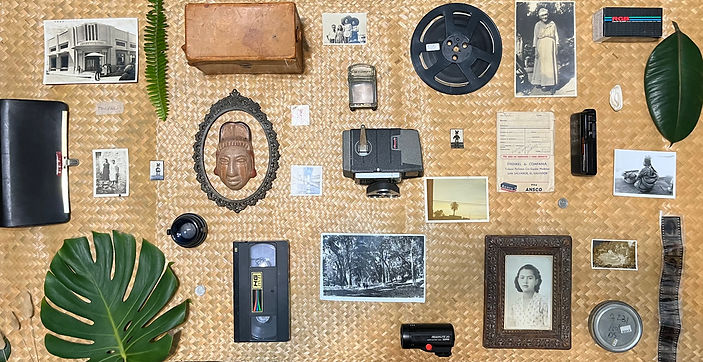
In dialogue with the Getty Museum’s presentation of Instante/revelación: Moments in Mexican Photography, the workshop addresses the practices of collecting, archiving, and storytelling, broadening the scope for whose stories are preserved, in what manner, and by whom. Participants will be asked to bring in an heirloom from their personal or family archives (photographs, letters, ephemera, small object etc.) and be guided through the process of recording an object-based oral history and generating metadata. Participants will leave with digital copies of all the documents they create stored on a USB drive as well as a sample archival enclosure for a photograph or document.
This workshop is part of CAHAAS's community engagement and cultural activism, advancing its mission to contribute and promote a broader understanding of the collective history of the Central American diaspora. By partnering with ESMoA, CAHAAS is working towards strong partnerships with other organizations equally invested in working alongside communities to bridge the cultural knowledge gap. ESMoA operates on a simple premise: art belongs to everyone, and a museum earns its place in a community by being useful to it. Its mission is to act as a catalyst for creative thinking in the South Bay and greater Los Angeles, provoking visitors to "Reimagine Creativity" through public programs that are always free and built with neighbors, schools, and local organizations rather than for them. Underlying that work is a belief that cultural institutions hold a real responsibility not only to display work but also to make room for the knowledge and memory already present in the surrounding communities.
Goals:
To introduce community members to the diverse tools and resources that are available to them to aid in the preservation and presentation of family and community histories.
To bring cultural institutions (ESMoA and Getty) and community members (organizers, artists, and young scholars) into dialogue around topics pertinent to the construction of a more comprehensive and inclusive history of communities in Los Angeles.
By the end of the workshop, you will know:
-
Oral History principles and techniques
-
Basic principles of preservation, researching, and building narratives around family histories
-
Best practices to care for and archive personal and family materials
Keepsake: Participants will take home a curated package of their heirloom that is properly stored, digitized, and cataloged.
Closing/Conclusion: Participants will have the opportunity to showcase their personal collection through a produced video vignette showcasing the project and its story.


RESOURCES

HANDOUTS:
DATABASES:
ORGANIZATIONS MENTIONED:
VIDEOS:


RETHINKIING
family history AS cultural preservation
THE PRESERVATION MOVEMENT
According to Latino in Heritage Conservation’s Equity Study, only 1% of sites on the National Register of Historic Places acknowledge Latinx contributions, leaving many vital places unrecognized and at risk. Laura Dominguez, a Los Angeles Cultural Heritage Commissioner calls for a paradigm shift: we need to move beyond 'exceptionalist' language and recognize that communities have been doing preservation all along. She is right. Our Central American footprints run deep in California, and your family history can make a difference in growing our cultural heritage in Los Angeles.
Preservation is power for our communities looking for dignity, stability, and belonging. Let's continue to grow our footprint by adding our stories and identifying historically significant sites to the Central American Heritage Map. Together, we can build networks and get these sites recognized through plaques, landmark designations, and more.
Culturally Significant Sites At-Risk Of:
-
Demolition
-
Closures
-
Gentifrication
-
Developers
-
Funding
-
Neglect
-
Climate Change
-
Recognition
 No funding for upkeep. |  Overlooked legacy business |
|---|---|
 No plaque |  Overlooked LGBTQ+ site |
 Overlooked legacy business |  Overlooked Garifuna Cultural Center |

ORAL HISTORY
PREPARATION
-
Formulate a central question or issue
-
Consider a release or consent form before starting a project.
-
Build the questionnaire around that individual with open-ended questions. Be sure the list captures the essential information about the family member.
-
Often the best way to begin asking questions is by asking about the individual's favorite home cooked-meal or their favorite song and where they first heard it, for example.
-
Schedule the date and time for the interview in a quiet and comfortable setting.
-
Prepare with more informed questions. Familiarize yourself with the subject in terms of their politics, economy, music, and culture.
-
Decide if you will be recording the interview, whether audio or video. This can help capture details more easily. Double check it!!
INTERVIEW
-
If recording, give yourself time before the sit down interview to set up equipment and it's working properly.
-
Bring to interview your questions and begin documenting the answers. Ask follow-up questions for clarification or even elaboration on an interesting topic.
-
Pay attention to visual and verbal cues; take water breaks
-
Allow time for answers outside the specific question. Let the individual’s memory run free.
-
It is okay to stay silent. Let your subject take the lead and you make sure your central question gets addressed.
ANALYZE
-
Identify and address the larger social relationships of power, particularly racism, colonization, patriarchy, and/or social class.
-
Identify the social injustices around race, climate change, and economic disparities that cause immigration from Central America to the US.
-
Examine the social, political, and economic disparities; whose perspective is heard and whose not?
-
What does family history reveal about dealing with racism, oppression, and/or inequalities? Or, what new information did you learn from your interview about challenges they overcame?
-
Were there any differences in lived experience from interviewee compared to your research? Again, whose perspective is heard and whose not?
-
How can you/we dismantle oppressive social systems?
RESEARCH
-
Research the history of the time period. Look into the politics, economy, music and culture of the times.
-
Reflect on erasures in archives and national narratives
-
Use tools like Google, databases, and books
-
Interview other family members
CRITICAL ACTION
-
How are you going to build on this?
-
Create a group to discuss social and political issues with peers
-
Communicate or negotiate with public officials
-
Mobilize collectively around a community-based issue
-
Coordinate a social media campaign to mobilize like-minded people
-
Explore storytelling, sharing, publishing
- Create art, music, community, profession
-
Deed of Gift Form for CAHAAS Digital Archive. Contact: team@cahaas.org
